
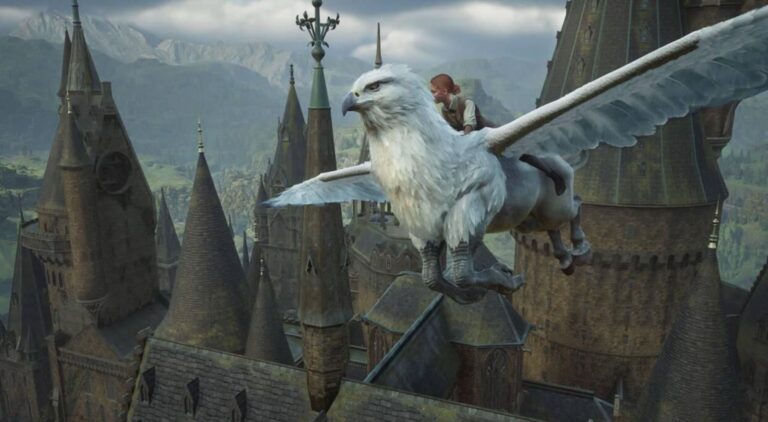
Hogwarts Legacy had one job that mattered more than all the others: make the castle feel real. It does that better than any adaptation before it, and most of what is uneven about the game comes from what it built around that success.
The castle is the actual achievement
Hogwarts here is not a hub with corridors between objectives. It is a building with an internal logic — floors that connect where you expect, windows that look out onto places you can reach, a geography you eventually navigate from memory instead of from the map.
That last part is the real test, and it passes. After a dozen hours you stop opening the map inside the castle. You know that this staircase gets you near the Great Hall and that shortcut skips the long gallery. Very few games earn that, because it requires a space coherent enough to be learned rather than merely dressed.
The density helps: portraits that comment, staircases that move, a hundred small animations that make it feel inhabited rather than decorated. But density alone does not produce navigability. The layout does, and someone spent a long time on it.
Combat is better than it needed to be
The easy version of this game is one where spells are reskinned attacks. What is here is closer to a puzzle-brawler: enemy shields are colour-coded to spell types, so encounters become fast reading problems rather than button contests.
Levioso to lift, Accio to pull something into range, Depulso to throw it back — the fun is in chaining them, and the spell wheel gives you enough room to build a genuine loadout. It is more mechanically interesting than it had to be.
The limitation is that it peaks early. By the midpoint you have found the combination that works, and the game keeps sending the same encounter shapes with more health. There is no second-act complication that forces you to rethink what you learned.
Where it frays: the game is not really about being a student
This is the honest gap. The fantasy being sold is attending Hogwarts. The game you play is an open-world action game that happens to have a school in it.
Classes are the clearest symptom. They exist as tutorial delivery — attend, learn the spell, and the subject essentially closes. There is no timetable to keep, no reason to return, nothing that makes Herbology a part of your week rather than a mission you completed. The thing most people wanted from a Hogwarts game — the texture of ordinary school life — is the thing least present.
Your fellow students suffer the same way. They are quest-givers with names rather than a peer group, and there is no version of the social simulation the setting invites. You can spend forty hours at this school without any relationship changing.
And the open world outside is the most conventional thing here: a competent map of camps and collectibles that could belong to any game, filled with a Merlin Trial count high enough to feel like padding. The castle is specific. The countryside is generic.
Performance, and being fair about it
Launch performance on PC was genuinely bad — stutter in Hogsmeade that patches improved substantially rather than eliminated. Console versions fared better. If you are picking it up now, this is much less of a story than it was, but it is worth knowing that the ray-traced modes remain expensive for what they add.
Who it is actually for
If what you want is to be somewhere — to walk a castle that rewards curiosity, find a passage you missed, and have the place hold together in your head — this is the best version of that ever made, and the criticisms above will not spoil it.
If what you want is a school simulator with lessons that matter and friendships that develop, that game has not been made yet. Hogwarts Legacy is a very good open-world adventure wrapped around an outstanding piece of architecture, and it is honest to say the architecture is carrying it.
Which, given how many adaptations get the place wrong entirely, is not a small thing to have got right.